The role of the USA as the world’s leading superpower is changing dramatically. In this interview, LMU political scientist Bernhard Zangl explains whether this means the USA will quickly lose influence, what China lacks as a rival, and whether the international order will come under even more pressure.
After 1945, the USA was one of the main initiators of the international order, but the country is now turning its back on it. What’s going on?
Bernhard Zangl: The United States is withdrawing from some international institutions like the World Health Organization (WHO). It’s thwarting others like the World Trade Organization (WTO). At the WTO, for example, it’s preventing new judges from being appointed to its dispute resolution body, the Appellate Body. This is actually blocking up the whole system. And at other institutions, such as the International Criminal Court, the USA is even trying to coerce other states to turn their back on these institutions.
But this is nothing new. The USA repeatedly pursued this strategy under Ronald Reagan, George W. Bush and in Donald Trump’s first term in office as well. Even Democratic Presidents have had their issues with international institutions. The USA’s policy of blocking judges at the WTO actually started under Barack Obama. Trump continued this policy, and Joe Biden didn’t correct it. It’s not all just a Trump effect, it’s also a USA effect.
Heading for a showdown
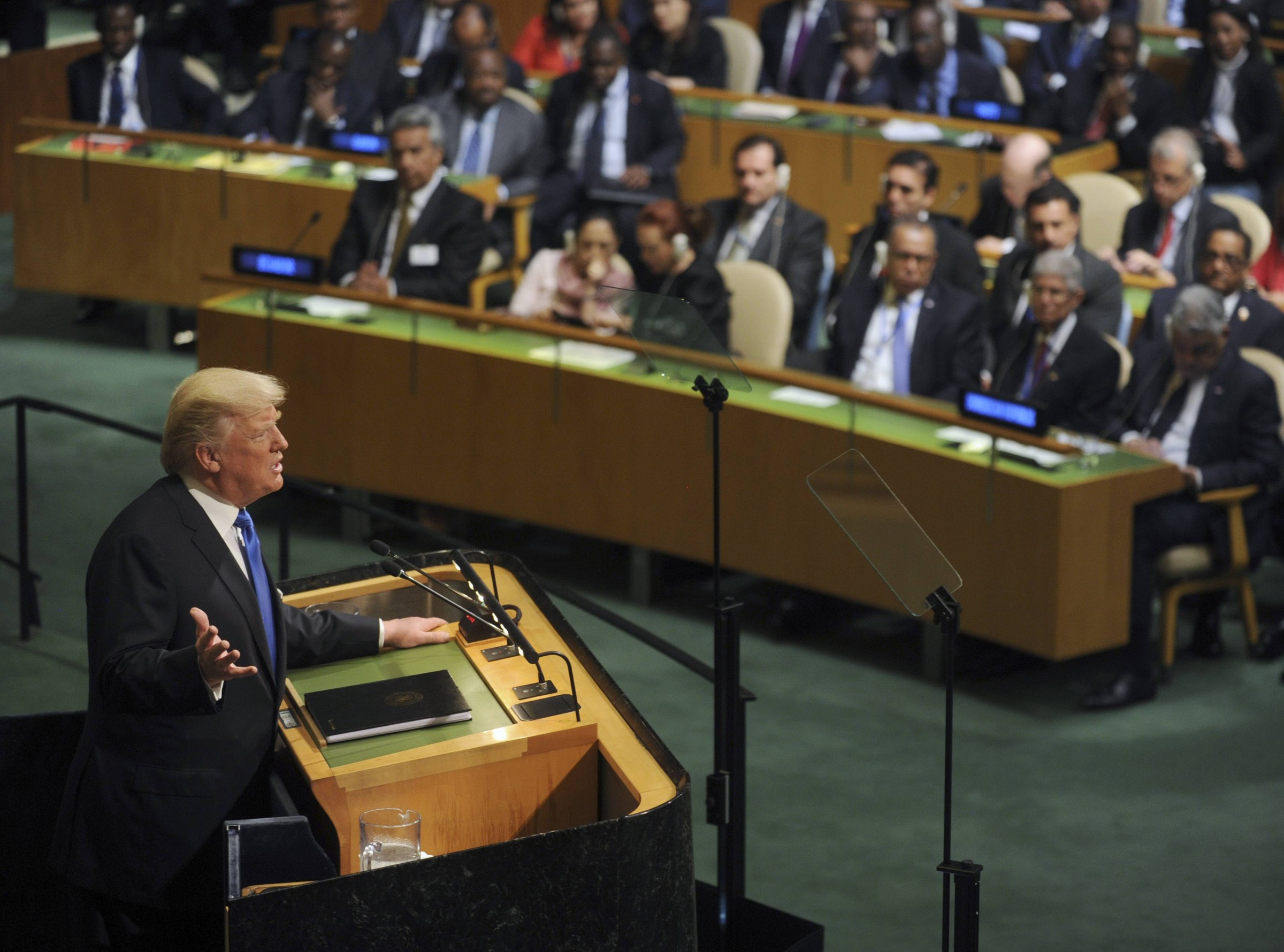
U.S. President Donald Trump at a United Nations conference: Trump is taking a stand against international organizations like no other American president before him. What are the consequences when a world power like the United States repeatedly withdraws from multilateral agreements and leaves international institutions?
And what’s the situation right now?
It’s taken on a whole new dimension in Trump’s second term in office. It’s a phenomenon right across the board that now affects 50 or 60 organizations. On previous occasions when the USA has withdrawn from organizations, the EU has often been able to pick up the slack. Climate is one example where the EU succeeded in keeping the Paris Agreement alive after the USA decided to withdraw from it during Trump’s first term as president. In other areas like the WHO, China is now stepping in and is of course creating a different focus.
Is there a bigger plan behind this new dynamic approach?
The USA is withdrawing mainly from international institutions that it can’t control. This is the reason for the blockade at the WTO, because the USA has relatively little influence over the judgments made by the judges on the Appellate Body. But when it comes to the UN Security Council, the situation is quite different. The USA has the right to exercise its veto, so the Council can’t pass any resolutions that don’t suit the USA. This is why the country doesn’t need to turn its back on this body. But the General Assembly, and therefore the UN as a whole, has fallen out of favor because the USA is unable to prevent many unpopular resolutions that are passed by majority voting.
»The USA is withdrawing mainly from international institutions that it can’t control.«
Bernhard Zangl
Does this mean we’re at the end of a cycle of power? "Yes", says Bernhard Zangl. "The dominance of the USA is dwindling and its current policies are helping accelerate its loss of power to China."
But it all started very differently. Perhaps you can take us back to the period after 1945 when the international order took shape.
After the Second World War, the situation was different. At the time, the USA was very keen to create an international order, together with the other victorious powers. The primary objective was to establish an effective order to maintain peace. This is how the United Nations was created, but unlike its predecessor, the League of Nations, this time a clear ban on the use of force and also the threat of force between states was enshrined in the Charter. It was the role of the Security Council to ensure that this was adhered to. In addition, the UN and its specialized agencies should also take due account of economic and social concerns.
What was it that gave the UN legitimacy and power?
The program to establish order, especially by the USA, after the Second World War was truly revolutionary and new. The UN was no longer about an imperial program in which a hegemon like Great Britain controlled territories largely without the say of the people who lived there. The USA openly championed a program of decolonization and stated that every country in the world was going to be included. Each state will have the institutional privilege to have its voice heard. In return for this, we demand that they support the organization. And this trade – recognition, involvement, privileges in return for support for the organization – has worked and given the UN great legitimacy.
But the fact that order was established so successfully soon also became a problem for the USA: It became increasingly important for the other states to be even more involved. This in turn meant that the USA occasionally lost control of these organizations – and so as time went on it lost interest too. This cooptation dilemma explains why the USA is today turning against the institutions it once founded.
»The number and influence of international institutions have been on the decline since the early 2000s. Instead, we’re now increasingly seeing smaller, bilaterial deals – for example the deals governing trade between the EU and Canada or the EU and India.«
Bernhard Zangl
But initially, wasn’t a network of liberal international institutions established?
This is perhaps the best way to illustrate the success story: The number of international institutions, so the number of treaties and organizations, has increased sharply since 1945, as has their authority. They’ve regulated not just the way that countries deal with one another, for example with the ban on the use of force or customs regulations, but also issues where they get deeply involved in the internal affairs of states – examples of this include the often-quoted issues of chlorinated chicken or hormone-treated meat.
The number of institutions kept increasing significantly through to the late 1990s, but then it stagnated. However, their number and influence have been on the decline since the early 2000s. Instead, we’re now increasingly seeing smaller, bilaterial deals – for example the deals governing trade between the EU and Canada or the EU and India.
And in many areas, no organizations or treaties that are binding under international law have been created for quite some time. There are informal agreements, or institutions like the G7 or the G20. Leaders convene, discuss something, then there’s a final communiqué. There aren’t just disadvantages to this. It can often take ten to fifteen years for major multilateral agreements that are set to become binding under international law to be fully negotiated and ratified. In informal institutions, things happen much faster, which is also important with an issue like climate protection, for example.
In the period after 1945, the international order wasn’t particularly successful at first. It failed to prevent the Cold War, and the UN or its Security Council at least was deadlocked. It was only after 1990, when the Cold War ended, that the Charter enabled the great powers to start working together to deal with conflicts and crises. For example, in the First Iraq War, the Security Council decided that the attack on Kuwait did indeed represent a threat to peace and authorized the USA and the countries allied with Kuwait to use force against Saddam Hussein. Following on from this, the Council empowered the USA and other mostly Western countries to intervene in a number of domestic conflicts within states – such as in Somalia.
But then came another turning point?
Yes, since 2000, for example, Russia has increasingly started blocking these kinds of activities again, and China also regards this as interference in the internal affairs of states. And this means the Security Council is paralyzed once again. The West, especially the USA, decided to intervene anyway – in the Kosovo conflict, for example, and in the Second Iraq War. Other countries have now used this as justification for flouting the ban on the use of force – one example is Russia, where President Putin ordered his troops to invade Ukraine.
But hasn’t the USA often broken international rules in the past?
Yes, that’s true, but they did at least attempt to provide justification for their actions under international law. The Kosovo War and the Second Iraq War are typical examples of this. But it’s these very kinds of justifications that the Trump Administration has decided no longer matter today. This is a big problem because rules under an international system only actually have an effect if everyone believes in them. But this belief is destroyed if breaking the rules no longer has to be justified and so becomes normal practice.
Battle mode
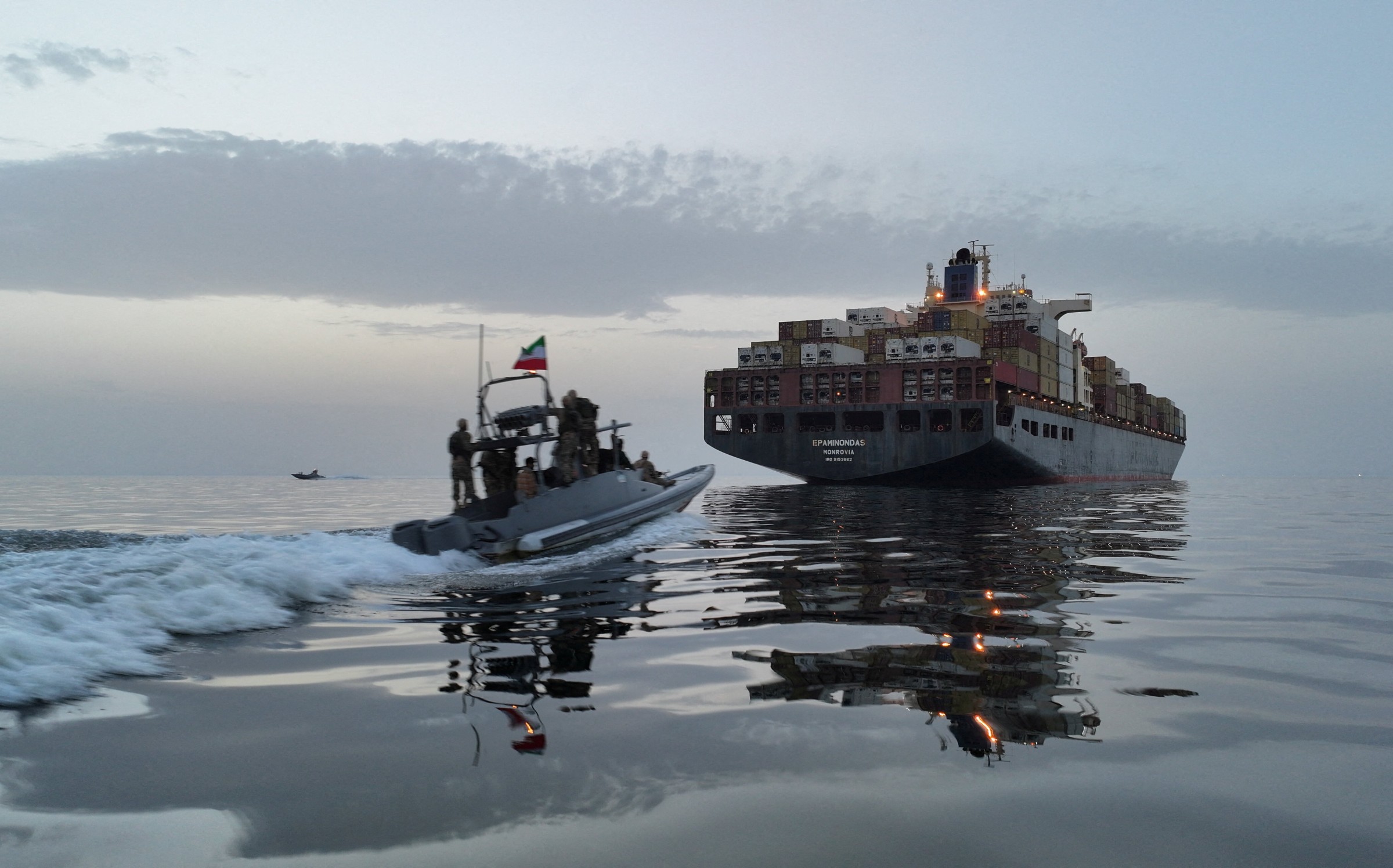
Is the United States, as a superpower, wasting too much energy on conflicts like the one with Iran? The Epaminondas ship is seen during seizure by the Islamic Revolutionary Guard Corps (IRGC) in the Strait of Hormuz, Iran, in this image obtained by Reuters on April 24, 2026.
Does this mean we’re at the end of a cycle of power?
Yes, the dominance of the USA is dwindling and its current policies are helping accelerate its loss of power to China. That’s because it’s currently getting involved in quarrels with its allies, not just in Europe. By doing this, the USA is throwing away the great advantage that it always enjoyed, especially in its rivalry with China: an extensive network of reliable allies around the world.
China is still reluctant to play a prominent role on the international stage, at least in international organizations. But in the background, it’s already tried to stand up to the USA in the relevant institutions. Might this possibly lead to a situation where China replaces the USA as a hegemon?
I think that’s certainly a possibility, but to be able to take on a hegemonic role, a country needs to have certain resources that the USA has in abundance. You need to be militarily and economically strong. Although China is still clearly no match for the USA militarily, things can change quickly. Economically, it’s already close to matching it. So China does now have the hard power that’s needed to take on such a role.
I have my doubts about whether China also has the soft power, the attractiveness that’s required. The USA had an attractive social model, democratic, free. The music, the movies, this was all very appealing to the rest of the world. Also human rights, this whole discourse. This had a real pull. And China doesn’t have this. But to be able to hold on to a position of hegemony over a long period of time, a country also needs to have this soft power.
It’s also possible that this battle between empires and worldviews could result in a stalemate, with nobody leading the way. Will the world then divide up into spheres of power, as some observers say?
That may well happen. Then the world would revert somewhat to the Cold War era with not just two, but probably three or four, maybe even five spheres of influence, each under the control of one leading power. Of course, the big question then is how will order be maintained between these blocs. Will there be any order at all? Will it be rules-based or a pure power struggle? To put it very modestly, you have to say that we need to save as much of the old world order as possible so it can still to some degree resolve disputes between these blocs in an orderly manner.
Bernhard Zangl holds the Chair of Global Governance and Public Policy at LMU’s GSI.
Humankind’s first calendars: Cuneiform expert Walther Sallaberger is researching how a common understanding of time 5,000 years ago created a sense of community and enabled city-states to function. Read now!
Smoldering conflicts, deceptive calm: Over 30 years ago now, violence erupted in the Balkans. What is the situation there today? Historian Marie-Janine Calic warns against forgetting the region. Read now!